Two tubs, same price, completely different contents. Processing, molecular size and dose decide.
Two tubs of collagen can carry the same price and contain almost nothing in common. One holds ten grams of a coarse flavored powder with added sugar, the other two grams of an odorless purified peptide.
Price is a poor guide to what a collagen product actually delivers. The label, read closely, is a better one.
Three numbers on the label
The first variable is processing. Raw collagen is too large to absorb, so it is hydrolyzed, broken into shorter amino acid chains the gut can take up. These are sold as collagen peptides or collagen hydrolysate.
Gelatin is an intermediate stage, partly broken down and still able to gel; peptides no longer gel and dissolve clear in water.
The second is molecular size, measured in daltons. Conventional hydrolysate runs 2,000 to 4,000 daltons.
Smaller fragments are absorbed in greater proportion, and certain short peptides, notably the proline and hydroxyproline pairing, appear in the bloodstream after ingestion and accumulate in the dermis. These are the fractions research treats as active.
The third is dose. Trials that report an effect on skin generally use 2.5 to 15 grams a day, and measurable absorption in the blood begins above roughly 154 milligrams.
A product that folds its collagen into a proprietary blend, without stating the amount, is concealing the one number that matters.
Source appears on the label as well. Cattle yield types I and III, fish mainly type I in small molecules, pork is widely used.
Often more decisive is what accompanies the collagen. Added vitamin C is defensible, since the body requires it for collagen synthesis. Flavoring, sweetener and color are not, and they raise the price per gram of the active ingredient.
The warning signs
Several warning signs are consistent. Collagen in a face cream does not act at depth, because the molecule cannot cross the stratum corneum.
Type II promoted for skin is misdirected; it belongs to cartilage. A proprietary blend with no quantities almost always masks a low dose.
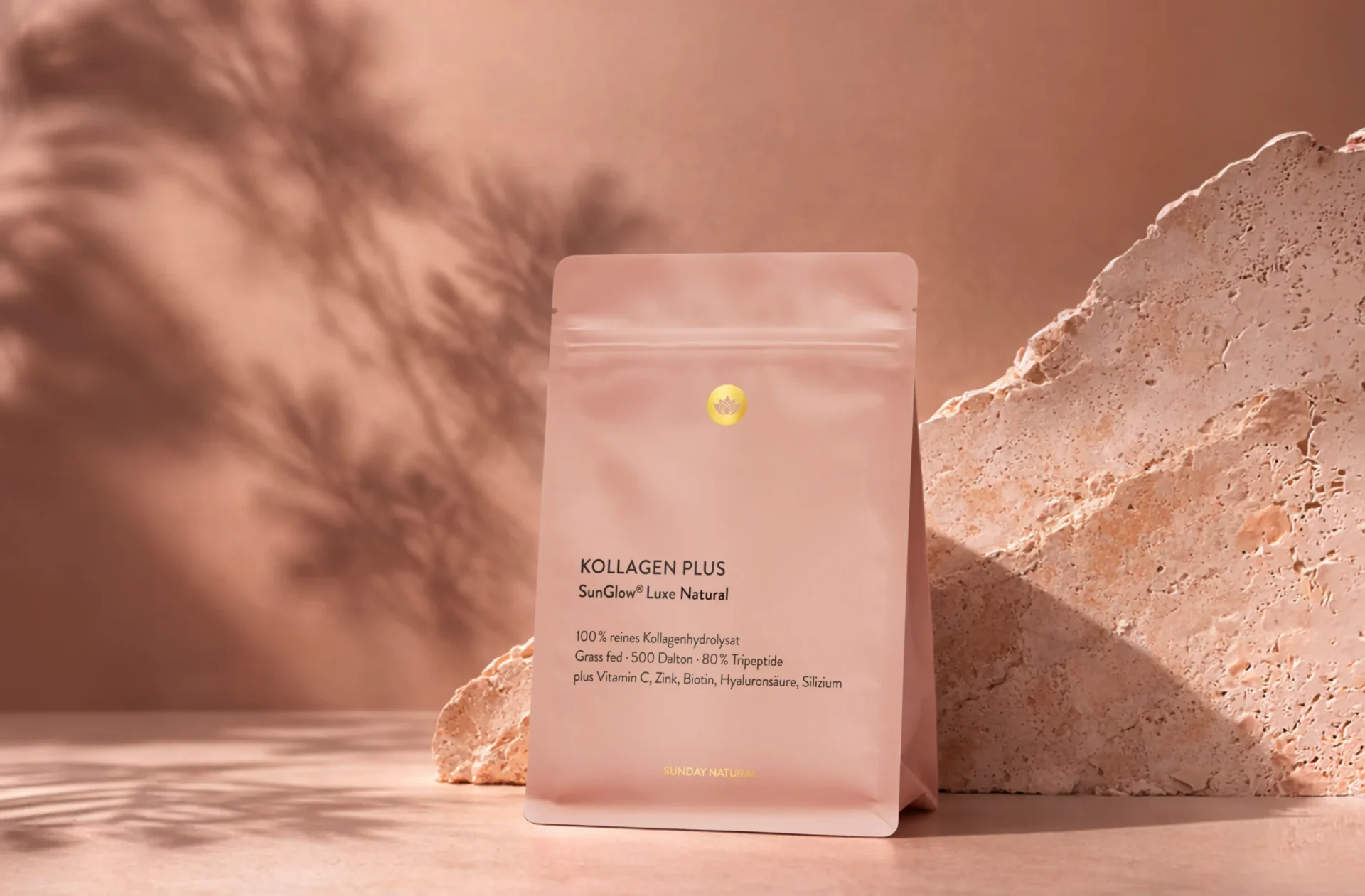
At the opposite end, Sunday Natural’s product is built on 2.3 grams of tripeptides, at least 80 percent short chains near 500 daltons, fully soluble and without added sugar; its specifications are published in full and can be compared directly against a competitor’s.
The figure on the front of the tub measures nothing useful. A fair comparison divides the price by the quantity of small peptides per serving. On that basis the cheaper tub is frequently the more expensive one.