
Labels advertise type I, type II, sometimes an alphabet of them. Only two types contribute to skin structure.
Collagen supplements advertise their type in Roman numerals, most often I, II or III, occasionally a longer list. For skin, the relevant distinction is narrow.
Of the collagen types the body produces, only two contribute to skin structure, and much of what appears on labels is either aimed at joints or included for appearance.
Collagen is a family of proteins rather than one substance. At least 28 distinct types have been described, together making up around 30 percent of the body’s protein.
Five of them, the fibrillar types I, II, III, V and XI, account for roughly 90 percent of the total. The remainder perform specialized roles in small quantities.
Every type shares the same basic architecture, a rope of three protein chains wound into a triple helix. The sequence depends on glycine appearing at every third position, the only amino acid small enough to fit the crowded center of the coil.
That structure is also why vitamin C matters: it enables the chemical step that locks the helix into a stable shape. Sailors with scurvy were, in effect, suffering collagen failure, their old wounds reopening because the protein could no longer hold.
The types that matter
Type I is the most abundant collagen in the body, present in skin, bone, tendon and ligament. It carries most of the tissue’s tensile strength and is the primary type in skin. Any claim about firmness is, in practice, a claim about type I.
Type III occurs alongside type I in skin and blood vessels, keeping tissue pliable. It is abundant in young skin, and its proportion declines with age, contributing to reduced elasticity. It is also the collagen the body deposits first during wound healing.
Type II is the exception. It is found almost exclusively in cartilage, and therefore targets joints rather than skin. Supplements built on type II are typically dosed at around 40 milligrams, often in an undenatured form whose mechanism differs from the hydrolyzed peptides used for skin. For skin it offers nothing.
The two forms of type II on the market work by different routes. Hydrolyzed type II, like the skin peptides, is broken into fragments and dosed in grams.
Undenatured type II, sold under trade names, keeps its native triple helix and is given at around 40 milligrams, on the theory that small amounts train the immune system to stop attacking cartilage. Whichever the mechanism, the target is the joint, and neither form has shown a meaningful effect on skin.
Type IV forms the basement membrane, a thin layer separating the epidermis from the dermis. Type V and the higher numbers regulate how the major fibers assemble. Neither has practical relevance for consumers, though both appear on labels to imply comprehensiveness.
The clinical importance of the types is easiest to see when one fails. Faults in type I collagen cause osteogenesis imperfecta, the brittle bone condition.
Faults in the genes for type III and type V underlie forms of Ehlers Danlos syndrome, in which skin stretches abnormally and joints dislocate. These are rare inherited conditions, not supplement territory, but they make the point a label cannot: each type does a specific structural job, and they are not interchangeable.
What you swallow is not what you build
One assumption the type labels encourage is false: swallowing type I collagen does not deposit type I collagen in the skin by direct transfer. Digestion breaks it into peptides and amino acids, which the body uses as raw material and as signals to make whatever collagen a tissue needs.
The type ingested is not the type built. This is why the size and dose of the peptides matter more than the Roman numeral on the front.
For skin, that reduces to type I and type III. Bovine collagen generally supplies both; marine collagen from fish supplies mainly type I in smaller molecules.
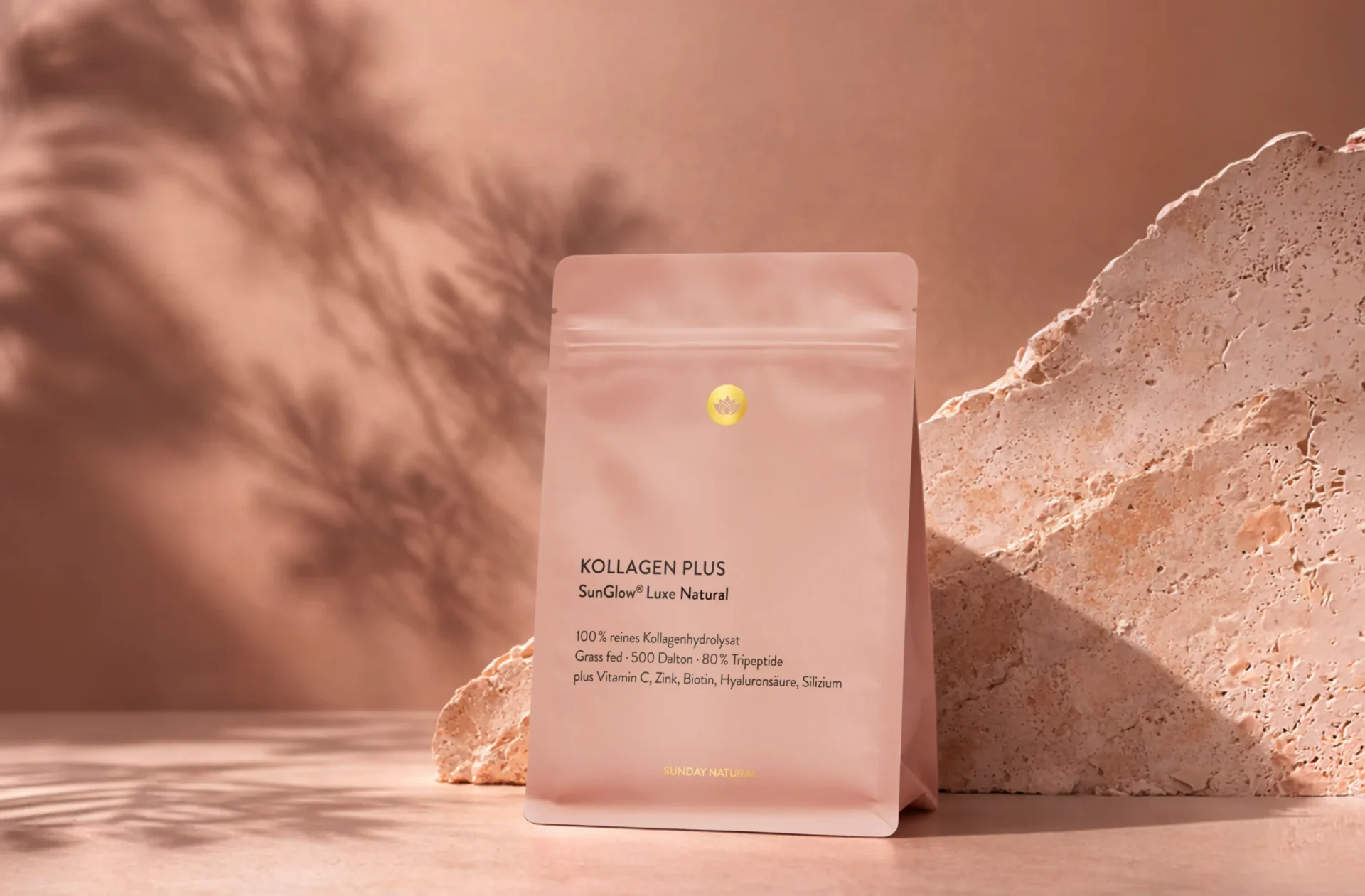
Whether a product lists type I alone or types I and III matters less than the size of the peptides and the dose. Sunday Natural sources its collagen from pasture raised cattle and hydrolyzes it into tripeptides so the fragments can reach the skin, an approach it details in full.
Source affects more than the type on the label. Marine collagen, extracted from fish skin and scales, tends to come in smaller molecules and is absorbed efficiently, though it carries a fish allergen risk and a higher price.
Bovine and porcine collagen are cheaper and supply types I and III together, but sit awkwardly with some dietary and religious restrictions. None of these origins is inherently superior for skin; what determines the effect is how thoroughly the raw protein is broken down and how much active peptide ends up in each dose.
A label listing five types implies more benefit than one listing two. For skin, three of the five are irrelevant.