
From the mid twenties, the body rebuilds collagen more slowly than it loses it. Sun, tobacco and sugar set the pace.
Human skin begins losing collagen faster than it can replace it from around the age of 25. The commonly cited figure is a decline of about one percent a year, a slow erosion that becomes visible only after a decade as thinning skin and lines that no longer relax.
The rate is not fixed. It responds to sun, tobacco and diet, which means much of it is under individual control.
Collagen is the most abundant protein in the body, accounting for roughly 30 percent of its total protein mass. In skin it forms the structural scaffold: type I provides tensile strength, type III lends flexibility.
In youth the fibers are dense and well ordered. With age the network loosens and grows brittle.
Two clocks, one face
Two clocks run at once. The first is intrinsic, the slow biological decline that would occur even in skin never exposed to sunlight, visible on the inner arm as fine lines and gradual thinning.
The second is extrinsic, driven mainly by ultraviolet exposure, and it is far more destructive. Dermatologists attribute the majority of visible facial ageing to sun rather than to years alone, which is why sun protected skin on the body often looks markedly younger than the face above it.
The wrinkling, the mottling and the leathery texture associated with age are largely photoageing, and largely avoidable.
Three factors accelerate the loss, and all three are behavioral. Ultraviolet radiation is the dominant one; it activates enzymes in the skin, the matrix metalloproteinases, that break down existing collagen faster than the body rebuilds it.
Smoking has a similar degrading effect and additionally restricts blood supply to the skin. Sugar acts through glycation, in which glucose molecules bond to collagen fibers and cross link them, leaving the tissue stiff and discolored. The end products of that reaction, known as AGEs, are measurable and accumulate with age.
Air pollution belongs on the same list. Fine particulate matter and the free radicals it generates degrade collagen through the same enzymatic route as ultraviolet light, and studies of urban populations link higher exposure to more pronounced pigment spots and wrinkles.
Skin at a busy roadside ages on a faster clock than skin in clean air, independent of sun.
At the cellular level the change is a loss of activity as much as a loss of material. The fibroblasts that produce collagen grow fewer and less responsive, and the scaffold they anchor to becomes fragmented, which lowers their output further.
Production of both type I and type III falls, and the ratio between them shifts, part of why older skin bruises more easily and heals more slowly. What remains is not only less collagen but a more disordered network of it.
The metaphor of an expiry date is therefore imprecise. Collagen does not disappear on a schedule. It is degraded, cross linked and replaced more slowly, at the same time, and cross linked fibers are almost never restored.
What slows the loss
Intervention works at the points of acceleration. Consistent sun protection is by a wide margin the most effective and least expensive measure. Not smoking follows. So does limiting rapidly absorbed sugars.
Vitamin C has a specific biochemical role here rather than a promotional one: the enzymes that assemble collagen cannot function without it, making it a direct cofactor in synthesis.
Diet sets the raw material. Collagen is built from amino acids, chiefly glycine, proline and hydroxyproline, which the body draws from dietary protein of any kind, not only from collagen itself. A diet short on protein starves the process regardless of what is applied to the skin.
Alongside vitamin C, the trace minerals copper and zinc act as cofactors when new fibers are assembled and cross linked correctly. No supplement compensates for a diet that lacks the underlying inputs.
Oral collagen peptides are the more recent and more heavily marketed approach. The evidence is modest but not absent. In a controlled trial, women aged 35 to 55 took collagen peptides daily for eight weeks and showed a measurable improvement in skin elasticity over placebo.
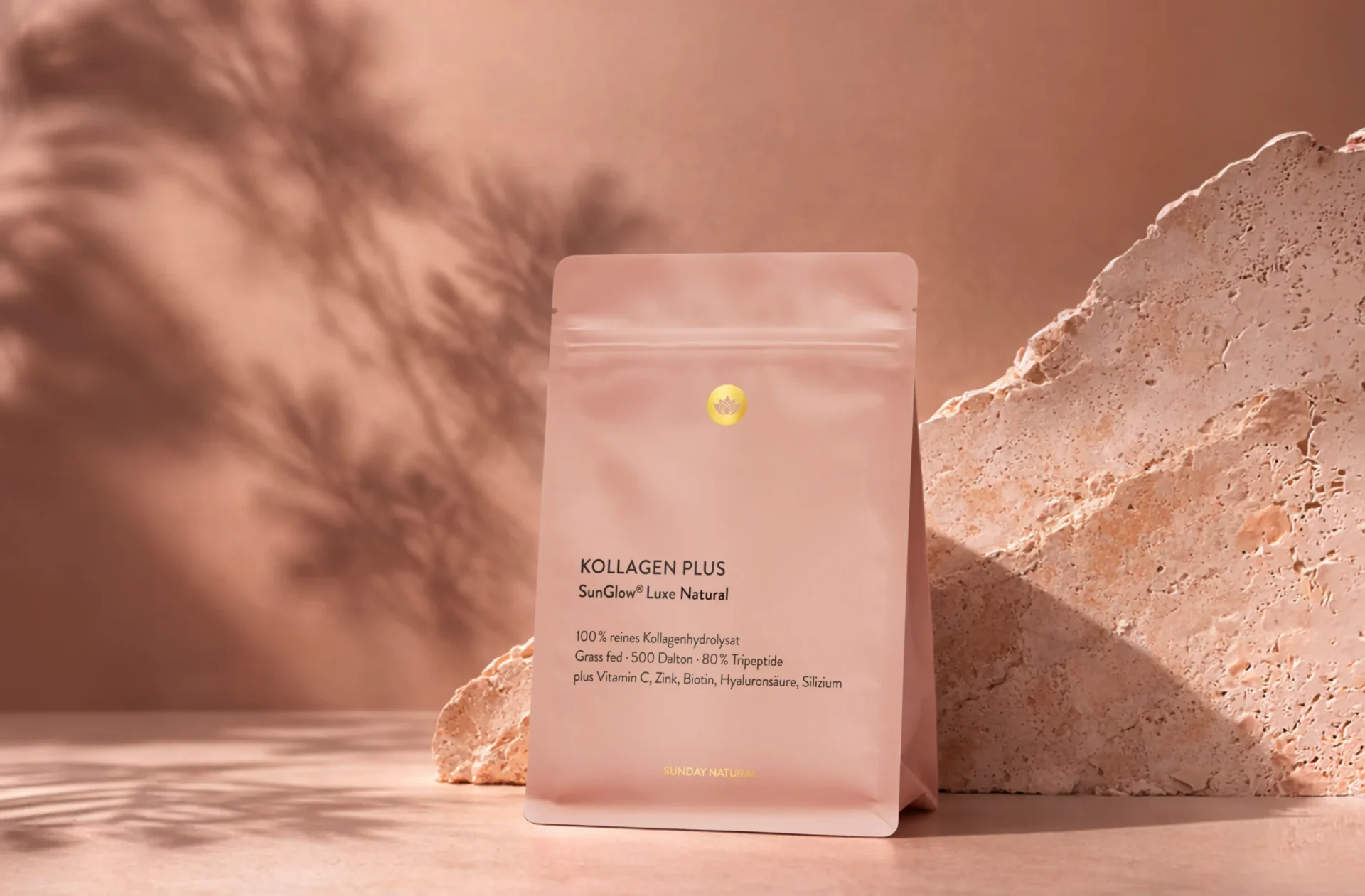
Absorption depends on fragment size, since only short peptides survive digestion intact and reach the dermis. Sunday Natural works with tripeptides of around 500 daltons, against the 2,000 to 4,000 daltons of conventional collagen hydrolysate, and documents the distinction.
What none of this does is restore youthful collagen once it is gone. Measures that slow the decline are well supported; claims to rebuild the dense, ordered network of a twenty year old are not.
The realistic aim is to preserve what remains and to add modestly at the margin, over years rather than weeks. On that scale the unglamorous interventions, daily sun protection and adequate protein, outperform any single product.
The date cannot be moved; the rate can. Between two people of the same age, the difference in their skin is rarely genetic alone. It reflects decades of accumulated sun, smoke and sugar, or their absence.