
In the five years after menopause, skin loses up to a third of its collagen. The evidence for supplements is modest.
The steepest loss of collagen in a woman’s life is driven not by age but by the fall in estrogen at menopause.
Skin loses as much as 30 percent of its collagen in the first five years after menopause, and about two percent a year thereafter. The mechanism is well established, which is also why the limits of any intervention are clear.
Estrogen regulates the fibroblasts, the dermal cells that manufacture collagen, and skin carries receptors for the hormone. When estrogen declines, the fibroblasts lose a signal to produce new collagen while breakdown continues.
The consequences appear quickly: thinner, drier skin, reduced elasticity, and lines that deepen over a short period. Many women describe the shift as abrupt rather than gradual.
The link is specific enough to measure. Research dating back several decades found that the collagen content of skin tracks the number of years since menopause more closely than a woman’s age in years, and that the sharpest fall comes early.
It is the loss of estrogen, not the passage of time, that sets the pace. The same decline appears in bone, where collagen forms the matrix that mineral hardens, part of why fracture risk climbs in the same window.
Timing shapes what any measure can do. Because the fastest loss falls in the first years after the final period, the window where prevention matters most is early, often during perimenopause when levels are already swinging.
Waiting until the skin has visibly changed means acting after the steepest part of the curve has passed. None of this makes later intervention pointless, but the return is larger earlier.
What the peptides do, and don’t
The question is whether oral collagen peptides can offset any of this. The evidence supports a partial yes.
In a controlled trial of women aged 35 to 55, a daily 2.5 gram dose improved skin elasticity significantly after eight weeks, with part of the gain persisting four weeks after supplementation stopped. Reviews pooling multiple trials report comparable improvements in hydration and elasticity.
The evidence carries qualifications. Many of these trials are funded by manufacturers, run for only a few weeks, and measure skin parameters rather than broader health.
Collagen does not replace estrogen or correct the hormonal deficit; women considering hormone therapy should raise it with a physician, not a supplement. The peptides do one thing, supplying building blocks and a synthesis signal to the skin.
Estrogen itself remains the most direct lever, and the evidence for it on skin is stronger than for any supplement. Studies of hormone therapy report gains in skin thickness, collagen content and hydration.
That is a medical decision with its own risks and benefits, weighed with a doctor against a woman’s wider health, not something to start for the sake of skin alone.
Topical estrogen has also been studied for the face, though it is not a routine treatment. The point is one of scale: peptides work at the margin of a process that hormones drive.
The change after menopause is not confined to appearance. Thinner skin tears and bruises more easily, wounds close more slowly, and the drop in collagen runs alongside losses in bone density and connective tissue elsewhere in the body.
Treating collagen loss as a cosmetic issue understates it. The skin is simply the visible edge of a systemic shift.
Where collagen has a role after menopause, it depends on an adequate dose, small peptides and a horizon of months rather than weeks.
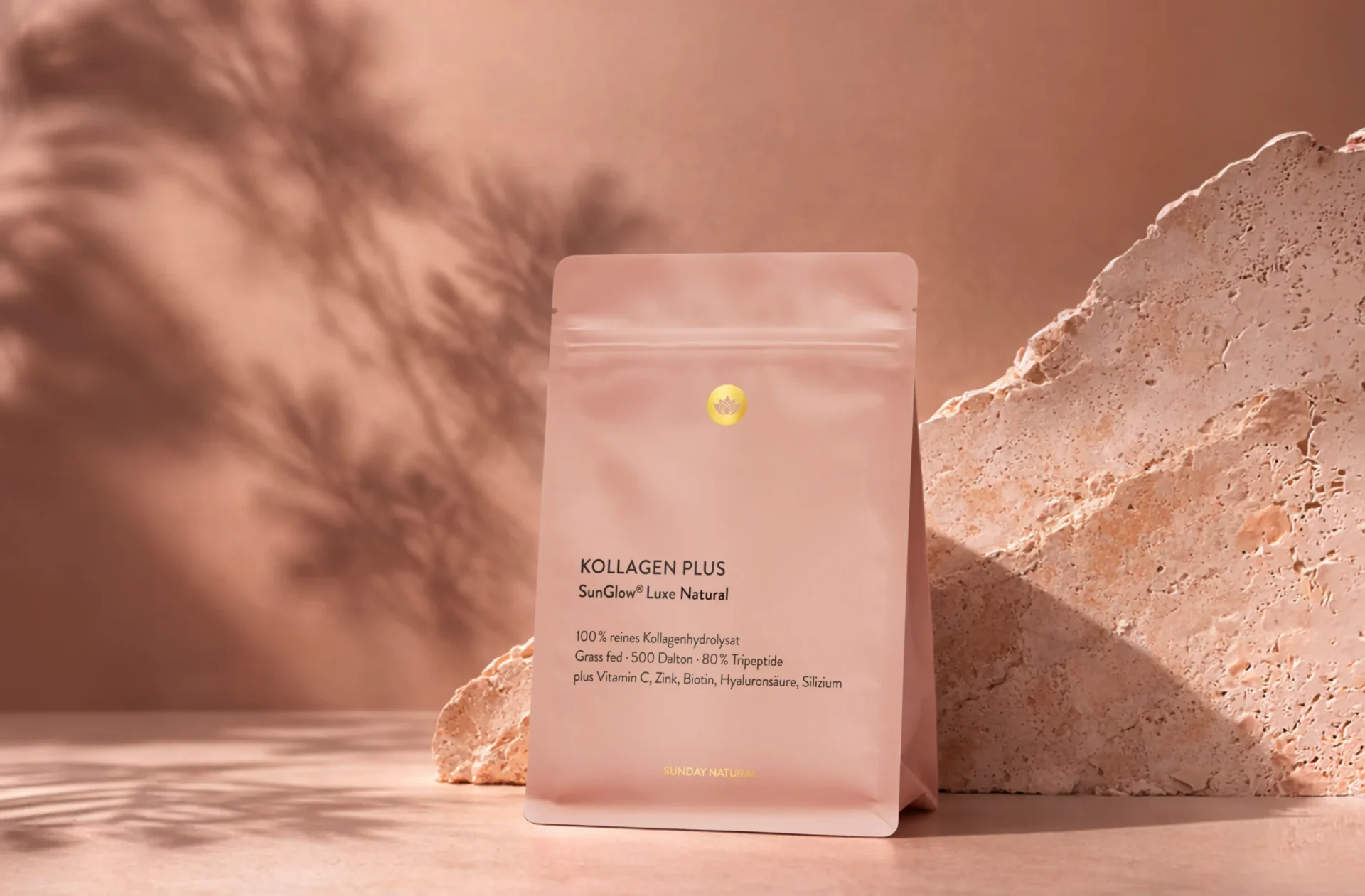
Fragment size determines how much reaches the skin. Sunday Natural uses tripeptides of around 500 daltons, combined in one variant with zinc, biotin and hyaluronic acid as supporting cofactors, and sets out the basis.
For a woman deciding what to do, the useful framing is additive. Sun protection preserves the collagen that remains. Adequate protein supplies the raw material. Resistance exercise supports the connective tissue under the skin.
A collagen peptide at a proven dose may add a measurable but modest improvement in elasticity and hydration on top of those. None of them alone is decisive; the effect, such as it is, comes from stacking them and holding to them over months.
Collagen does not reverse menopause. At best it moderates the sharp loss of the first years, no more. For many women that margin is worth testing, provided the expectation is set at the right level.